Atomic Habits
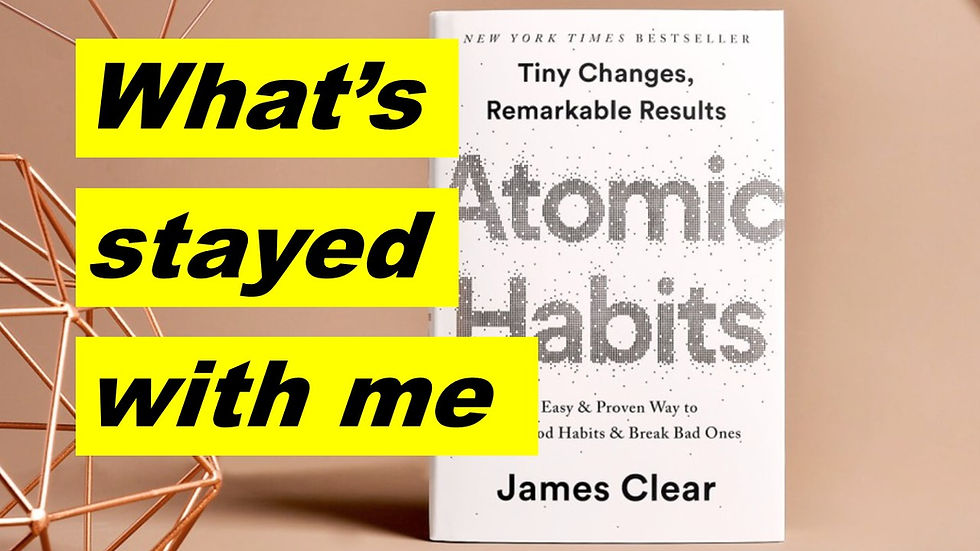
“Every action is a vote for the person you want to be.”
When I first read that line from James Clear’s Atomic Habits, it drew me in like a moth to a flame. I’ll admit to a bit of selection bias here, but I have always maintained an impassioned stance that intentional action is the only true measure of a person.
We live in a world overflowing with intentions. It is incredibly pervasive, especially now, to see a heavy emphasis on talk, talk, talk, with absolutely zero walk, walk, walk to back it up. The grit, the determination, the simple willingness to actually put your head down and do the hard work seems frustratingly evasive these days.
That’s why Clear’s framing of action as the ultimate measure of value and identity is so intoxicating. It strips away the excuses and the empty words. You are what you repeatedly do.
Here are the eight concepts from the book that have stuck with me after several months.
The Compound Interest of Self-Improvement
We are obsessed with overnight success, but the reality is that tiny improvements, compounded over time, create massive differences. Getting just 1% better every day isn't particularly notable in the moment but over months and years, the math becomes undeniable.
Habits are the compound interest of self-improvement. This concept always reminds me of a quote I love by the French philosopher Voltaire:"Le mieux est l'ennemi du bien"—or as I like to interpret it, "perfect is the enemy of progress." The biggest takeaway for my own learning is that waiting for a flawless solution is a trap. If you refuse to make small improvements because they aren't perfect, you just end up paralyzing your growth. For an organization, this perfectionism is incredibly costly, as it delays the compounding impact of those vital 1% improvements. It is deeply reminiscent of my own thoughts on defining excellence: true excellence is rarely a single, perfect stroke of genius, but rather requires an "unrelenting, habitual commitment" to the "long-term grind."
Systems Over Goals
Goals are about the results you want to achieve; systems are about the processes that lead to those results. If you completely ignored your goals and focused solely on improving your daily processes, you would still succeed. As explored in the Growth Mindset post: Process, not result. Winners and losers often have the exact same goals. It’s the daily system that separates them.
How Habits Shape Your Identity
True behavior change is identity change. You might start a habit because of motivation, but the only reason you’ll stick with it is that it becomes part of your identity. The goal isn't to read a book; the goal is to become a reader. Every time you hit the gym, you are casting a vote for the identity of an athlete. You don't just do the thing; you become the thing.
Habit Stacking
This is the tactical execution of getting things done. Instead of pairing a new habit with a particular time or location, you pair it with a current habit. “After I pour my morning coffee, I will meditate for one minute.” It takes advantage of the neural networks you’ve already built and seamlessly integrates new actions into your established routine.
The Photography Study: Action vs. Perfection
James Clear references a fascinating study where a photography professor divided his class into two groups: the "quantity" group (graded solely on the number of photos they submitted) and the "quality" group (graded on producing just one nearly perfect photo).
At the end of the term, the best photos universally came from the quantity group. Why? Because they spent the semester actually doing the work—taking photos, making mistakes, and actively learning from them. The quality group, meanwhile, spent the semester paralyzed by theorizing about perfection and ultimately produced mediocre results. In their endless pursuit of flawless execution, they proved yet again that waiting for perfect stalls progress (a second nod to Voltaire in one post 😉). The reality is that the only true path to greatness is forged by putting in the messy, imperfect reps.
Motion vs. Action
Being in motion feels like progress, but it rarely produces a result. Researching the best workout plan is motion. Doing ten pushups is action. We often get stuck in motion because it allows us to feel like we are doing something without running the risk of failure.
This directly connects to one of my favorite maxims: Culture eats strategy for breakfast. Strategy is motion—it is the plan, the theory, the whiteboard drawings. Culture is action—it is the actual, unglamorous daily habits and standards of the people in the room. A great strategy will always be devoured by a culture of poor daily execution.
The All-or-Nothing Pitfall
Perfect compliance is a myth. People often think that missing a repetition ruins the entire goal, leading to an all-or-nothing mindset where a single slip-up causes them to abandon the habit entirely.
I’ve talked about this with my son as a young athlete he can get discouraged in the doldrums of pursuing his own goals. 50% of the time it is easy. You are motivated and enthusiastic and you want to train and practice. However, the other 50% of the time you are some combination of indifferent, unmotivated and lethargic. You don't need to be perfect. You can have bad days and off-performances, so long as you forgive yourself and focus on what is next. If you can commit to winning half the battles on your worst days, then if gives you a cushion to fail small and keep going. You keep yourself in the fight. Resilience outlasts perfection.
When Genes Matter (And When They Don't)
Genes do not eliminate the need for hard work; they simply clarify what you should be working hard on.
This mirrors legendary basketball coach Don Meyer’s framework that I love regarding the difference between AA, AB, and BA athletes (Attitude and Ability).
BA (Bad Attitude, High Ability): The player with great genes who relies solely on talent and inevitably gets passed by.
AB (Awesome Attitude, Low/Average Ability): The player who maximizes every ounce of their genetic potential through relentless effort.
AA (Awesome Attitude, High Ability): The unicorn. The elite talent who works like they have none.
Clear’s point, and Meyer’s point, is the same: your genes give you your baseline, but your habits dictate your actual ceiling. You don't get to choose your starting line, but you have absolute control over whether you put in the work to reach the finish.
Selection Bias
A brief caveat on that selection bias I mentioned earlier: it is dangerously easy to build an intellectual echo chamber. When the resources I consume line up so neatly with my past writings and deeply held beliefs about intentional action, I have to pause and ask the hard question: Am I limiting my growth by only being attracted to resources that affirm my existing beliefs? True development, the kind that allows us to find genuinely creative solutions and help others reach their full potential, requires friction. To push beyond my current baseline, I need to intentionally seek out contrasting perspectives and rigorous critiques of the very systems I champion. Comforting affirmation might feel good, but growth rarely happens in a room where everyone is simply nodding in agreement.


